Example calculation for 8001 Zürich, born 1985, employed. Change the details above to see your premiums.
ModelWhat do the models mean?
Standard: free choice of doctor, you go directly to any doctor or specialist.
Family doctor: always go to your chosen family practice first (with some insurers only from a list). It refers you to specialists.
HMO: you are tied to a specific health centre. Treatment and referrals go through this centre.
Telmed: before every doctor’s visit, call the telemedicine centre or check via the insurer’s app first.
Emergencies are exempt, usually also gynaecologists and ophthalmologists. If you do not follow the rules, you risk reduced benefits or being moved back to the more expensive standard model.
Your insurer does not offer this model in your region. Please check the model on your policy.
Insurer and modelHistory since 2016 · vs. 2026Premium per monthSaving
Found a cheaper insurer?
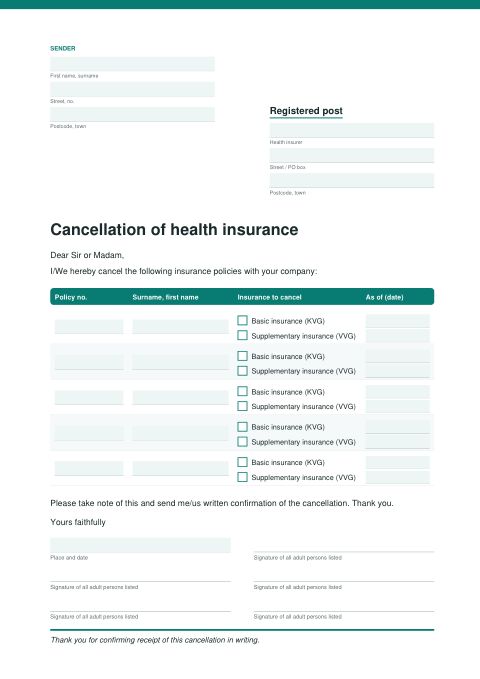
Download the cancellation form for your current insurer right here (PDF). For basic and supplementary insurance, up to 5 people, can be filled in on the computer. The cancellation must reach your insurer by 30 November at the latest.
Even easier online: choose your current insurer from the list and the cancellation address is inserted into the PDF automatically (all 32 insurers). Add the people and the cancellation date, and we show the deadline for posting it. You get a finished PDF ready to sign. Nothing is sent to us.
No gap in cover when you switch: for basic insurance, your current insurance only ends once the new insurer has confirmed that you are insured without interruption (Art. 7 para. 5 KVG). Until then, you remain insured with your old insurer.
Premium history
Annual figures as a table
Source: FOPH, dataset “Health insurance premiums” on opendata.swiss, as at 29.9.2026. For each insurer and model, the cheapest approved rate, rounded to 10 centimes. Discounts for the third and further children are not taken into account. The insurer’s quote is binding.
Your situation
What’s coming up for you?
Special rules apply to these life events. Here is what you need to know.
Basic insurance does not pay for many things. See how much each insurer contributes towards complementary medicine, fitness, massages, glasses, travel and teeth, and request your personal offer.
Outpatient supplementary insurance of selected health insurers compared
Choose what matters to you and see which insurers’ products include these benefits. Up to three products can be compared side by side.
Prenatal insurance
Insure your baby before birth
If you register your child before birth, they get supplementary insurance without a health check. Even if the baby is born with a condition or a malformation, they are fully covered from the very first second.
No health questions for dental, hospital and outpatient supplementary insurance
We obtain the binding quote from the insurer, check it with you and help you switch. Free of charge and without obligation for you.
Your selection is already includedWe take the insurer, model, deductible and place of residence straight from the calculator.
Personal, not a call centreYou decide whether we e-mail or call you, and when.
In good time before 30 NovemberOn request, you will receive a cancellation template for your current insurer.
Advice from FINMA-registered intermediaries Our advisers meet the requirements of the revised Insurance Supervision Act (ISA) and are listed in FINMA’s register of insurance intermediaries (F01471874, F01495797). Legal notice
Neutral advice, with experience since 1978 Kurt Stahl has been advising insured people in Switzerland since 1978 on a simple principle: the customer comes first. The right solution for you comes before our commission. Today he passes on his knowledge to our advisers as a referral partner. The calculator shows all 32 health insurers from the official FOPH data, not just our contract partners. If the insurer that suits you best has no contract with us, we pass your enquiry directly to that insurer free of charge, even though we earn nothing from it. Mystery-shopping tests by consumer protection organisations have found no fault with this way of working.
Around 32 insurance groups and independent insurers offer basic insurance. The five largest together cover more than half of the population; many small insurers operate only regionally. Basic insurance benefits are the same everywhere, so the premium is what matters.
Swiss health insurers by number of insured persons
Rank
Group / insurer
Associated insurers (brands)
Insured persons (approx.)
Head office
1
Helsana Group
Helsana, Progrès
1'598'000
Dübendorf (ZH)
2
CSS Group
CSS, Sanagate (integrated)
1'562'000
Lucerne (LU)
3
Groupe Mutuel
Avenir, Easy Sana, Mutuel, Philos, SUPRA, AMB
949'500
Martigny (VS)
4
SWICA
SWICA
860'000
Winterthur (ZH)
5
CONCORDIA
CONCORDIA
730'000
Lucerne (LU)
6
Assura
Assura-Basis SA
722'000
Pully (VD)
7
Visana Group
Visana, sana24, vivacare
700'000
Bern (BE)
8
Sanitas Group
Sanitas, Compact
650'000
Zurich (ZH)
9
KPT
KPT / CPT
490'000
Bern (BE)
10
Sympany
Vivao Sympany, Moove Sympany
210'000
Basel (BS)
11
ÖKK
ÖKK
185'000
Landquart (GR)
12
Atupri
Atupri
175'000
Bern (BE)
13
EGK
EGK Grundversicherungen
85'000
Laufen (BL)
14
Agrisano
Agrisano
80'000
Brugg (AG)
15
Aquilana
Aquilana
65'000
Baden (AG)
16
KK Hinterland
Krankenkasse Lucerneer Hinterland
25'000
Zell (LU)
17
Provita
Provita (partner of SWICA)
25'000
Winterthur (ZH)
18
KK Steffisburg
Krankenkasse Steffisburg
20'000
Steffisburg (BE)
19
rhenusana
rhenusana
15'000
Heerbrugg (SG)
20
Glarner
Glarner Krankenversicherung
12'000
Schwanden (GL)
21
SLKK
SLKK
11'000
Zurich (ZH)
22
sodalis
sodalis gesundheitsversicherung
9'500
Visp (VS)
23
KK Einsiedeln
Einsiedler Krankenkasse
9'000
Einsiedeln (SZ)
24
Sanavals
Sanavals Gesundheit Kasse
5'000
Vals (GR)
25
Birchmeier
Birchmeier Krankenpflegeversicherung
4'500
Künten (AG)
26
vita surselva
Krankenkasse vita surselva
4'000
Ilanz (GR)
27
Cassa da malsauns
Lumneziana
3'000
Vella (GR)
28
KK Wädenswil
Krankenkasse Wädenswil
3'000
Wädenswil (ZH)
29
KK Turbenthal
Krankenkasse Turbenthal
2'500
Turbenthal (ZH)
30
KluG
KluG Krankenversicherung
2'000
Zug (ZG)
31
Kolping
Kolping Krankenkasse (Grundversicherung)
1'500
Dübendorf (ZH)
32
Galenos
Galenos Krankenversicherung
1'000
Zurich (ZH)
Total (approx.)
9'214'500
Number of insured persons rounded, based on publicly available information (as of 2026), without guarantee. Figures may differ depending on the source and reference date. Some insurers do not offer basic insurance in every canton; the calculator shows those available where you live. Insurers offering only daily sickness allowance are not listed.
More than the premium: service and financial strength
★Service and customer satisfaction
Basic insurance benefits are the same by law, the service is not. In everyday life, what matters is how an insurer treats you.
What to look out for?
Reimbursement: how quickly do you get money back for submitted bills?
Accessibility: phone, chat, app and customer portal, waiting times
Goodwill: how generous is the insurer in borderline cases with supplementary insurance?
Clarity: understandable statements and information
Comparison services and consumer magazines publish annual surveys on this. The ratings are based on policyholders’ opinions and can change from year to year.
Every insurer must hold sufficient reserves. The solvency ratio, published annually by the FOPH for each insurer, shows how well it is doing.
What to look out for?
At least 100 %: below that, the insurer must present measures to the FOPH and rebuild its reserves.
Low reserves: an insurer that calculates tightly and is very cheap today often has to raise premiums more sharply the following year.
Very high reserves are not ideal either: policyholders paid premiums that were too high. Insurers may reduce excess reserves.
No need to worry about benefits: basic insurance is guaranteed by law, and you can switch again every year.
The solvency ratio is a snapshot (as of 1 January). Together with the premium history in the calculator, it gives a better picture than the premium alone.
Since the Health Insurance Act (KVG/LAMal) came into force in 1996, the number of licensed basic insurers in Switzerland has fallen from 145 to 32 (as of 2027) through takeovers, mergers and consolidation within groups. This drop of more than 110 providers happened over three decades in three big waves: first, regional and company insurers joined together to form national groups; then the large groups streamlined their own multi-brand structures.
1. How the large groups were formed and streamlined
Many well-known brands from the 1990s did not disappear through bankruptcy. They were first brought into large holding companies and later legally merged.
Formed in 1996 from Helvetia and Artisana. For years it ran its own basic insurers (Progrès, Avanex, Sansan), which were merged step by step into the main insurer Helsana between 2017 and 2022.
CSS Group
Intras, Arcosana, Sanagate, Auxilia
Took over Intras from western Switzerland (2007). Set up low-cost subsidiaries (Sanagate, Arcosana), which were later integrated back into CSS.
Grew through dozens of takeovers in French-speaking Switzerland (including Supra-1846). Kept streamlining its structure, most recently in 2025 (Supra, Easy Sana) and on 1 January 2027 (AMB, CMVEO), down to three basic insurers.
Visana Group
KKB, Grütli, sana24, vivacare, Galenos
Formed in 1996 from KKB and Grütli. Later integrated regional insurers and its own subsidiaries sana24 and vivacare.
Sanitas Group
KFW (Krankenkasse Winterthur), Compact, Wincare
Took over Wincare from Winterthur Insurance. Integrated the subsidiaries Compact and Wincare into Sanitas Grundversicherungen.
SWICA
Provita, Ospita, Zürich-Krankenkasse
Formed in 1992 from four insurers (including Ostschweizerische and Winterthurer) and later took over Provita (Winterthur).
Formed in 2008 from ÖKK Basel. Took over the policyholders of Kolping Krankenkasse in 2024.
2. Notable takeovers and portfolio transfers
Alongside the restructuring within groups, there were many well-known individual takeovers by other mid-sized insurers or because of financial difficulties:
Assura. Took over the western Swiss insurers Fédération Vaudoise and parts of Avanex, as well as Sanavals from Valais (portfolio transfer).
Concordia. Integrated various local insurers, including Krankenkasse Kloten and Krankenkasse Turbenthal.
KPT. Took over Publisana (the former insurer of federal employees), among others.
ÖKK (Landquart). Formed from a merger of insurers in Graubünden and took over several regional insurers in eastern Switzerland.
Atupri. Formed in 2002 from the former SBB health insurer (health insurer for Swiss Federal Railways staff) and later entered into a strategic partnership with Visana.
KLuG Krankenversicherung (Zug). Was dissolved after a mid-year premium increase ordered by the authorities and solvency problems; its policyholders were transferred.
Krankenkasse Institut Ingenbohl. This long-established convent insurer returned its licence at the start of 2024.
3. What became of the former company and regional insurers
30 years ago, two types of insurer shaped the market. Today they have almost completely disappeared:
Company health insurers. Insurers such as those of Swissair (Aerosana), Sulzer, Bührle, Georg Fischer, Ciba-Geigy, Migros or PTT/Swiss Post lost their exclusive access to employees with the KVG. Almost all of them were sold to large groups (mainly Helsana, SWICA, Sanitas and Visana).
Local and village insurers. Of the hundreds of municipal insurers (especially in the cantons of Zurich, Bern, Graubünden and Valais), most merged for cost and solvency reasons with regional insurers such as Sodalis (Valais), Sumiswalder (Bern) or SLKK (Zurich).
Summary based on publicly available information, without guarantee. In a merger, the benefits of basic insurance stay the same, and you can switch at the end of the year as usual.
Your cancellation must reach your health insurer by 30 November at the latest; you then switch on 1 January. Send it by registered post and in good time. Your existing insurance only ends once the new insurer has confirmed that you are insured without a gap. With the ordinary deductible of CHF 300 in the standard model, you can also switch at the end of June, with cancellation by the end of March.
You can use our form for the cancellation. It applies to basic (KVG) and supplementary insurance (VVG) and for up to five people. You can fill it in directly on your computer or print it out and fill it in by hand. Then sign it and send it by registered post.
How it works in 3 steps
Download the form and fill it in on your computer or by hand.
Sign it: every adult signs personally, parents sign for their children.
Send it by registered post so that it reaches your current insurer by 30 November at the latest.
Even easier online: choose your current insurer from the list and the cancellation address is inserted into the PDF automatically (all 32 insurers). Add the people and the cancellation date, and we show the deadline for posting it. You get a finished PDF ready to sign. Nothing is sent to us.
No gap in cover when you switch: for basic insurance, your current insurance only ends once the new insurer has confirmed that you are insured without interruption (Art. 7 para. 5 KVG). Until then, you remain insured with your old insurer.
Yes. Our advisers are listed as insurance intermediaries in FINMA’s public register of intermediaries (Alessio Sarubbi F01471874, Roman Krasniqi F01495797) and meet the requirements of the revised Insurance Supervision Act (ISA/VAG), including those on training and continuing education. You can check these entries yourself in FINMA’s register. We compare offers from different health insurers; the premiums in the calculator come from the official FOPH data. Our advice is free of charge and non-binding for you.
Our principle since Kurt Stahl started advising in 1978: our advice is open-ended. If the health insurer that best fits your situation has no intermediary contract with us, we still pass your quote request directly to that insurer, without any commission for us. Mystery-shopping tests by consumer protection organisations have found no fault with this.
How to recognise trustworthy advice is explained in our guide; all company details are in the legal notice.
When should I insure my baby?
Ideally before birth, preferably in the 5th to 7th month of pregnancy. Health insurers will then also accept your child into supplementary insurance without a health check. You only pay premiums from the month of birth. For basic insurance, you have three months after the birth, and it then applies retroactively.
Are the benefits the same with all health insurers?
Yes. Basic insurance benefits are set by law and are identical with all insurers. The differences are in premium, model and service. Every insurer must accept you for basic insurance without health questions.
Do I need accident cover?
If you work at least 8 hours a week for the same employer, you are insured against accidents through your employer and can exclude accident cover from your health insurance. For children, the self-employed, people not in work and pensioners, it remains included. What else changes when you retire is explained in our retirement guide.
What do family doctor, HMO and Telmed mean?
With these models, you first go to your family doctor or an HMO health centre, or call a telemedicine service. In return, the premium is usually lower than in the standard model with free choice of doctor. Emergencies are always exempt. Before switching, check whether your family doctor is on the insurer's list or whether the insurer has an HMO health centre near you, and which rules apply, for example whether you have to call before every visit to the doctor or use an app. If you do not follow the rules, you risk benefit cuts.
Which deductible is right?
With the highest deductible of CHF 2'500 you pay the lowest premium, but bear more of the costs yourself. On top of this there is a retention of 10 % of the costs, at most CHF 700 per year (children CHF 350). Whether the high deductible pays off depends on your expected costs. For adults, the threshold is around CHF 2'000 of doctor, hospital and medication costs per year: below that, the CHF 2'500 deductible usually works out cheaper; above it, the CHF 300 deductible. The reason: for the CHF 2'500 deductible, insurers may reduce the premium by no more than CHF 1'540 a year (70% of the additional risk of CHF 2'200). If your insurer gives a smaller discount, the threshold is lower. The deductible calculator works it out with your own figures, and we are also happy to do so during our advice.
I am moving to Switzerland or am a cross-border commuter. What applies?
If you move to Switzerland, you must take out basic insurance within three months of taking up residence; it then applies retroactively from the date of arrival. Cross-border commuters from Germany, France, Italy and Austria can choose within three months of starting work whether to insure themselves in Switzerland or in their country of residence.
No, it is voluntary. Basic insurance pays for the general ward of a listed hospital, but outside your canton of residence only up to the rate of your canton of residence. With supplementary hospital insurance, you can choose your hospital freely anywhere in Switzerland, and with semi-private or private also your room and doctor.
From the premiums approved by the Federal Office of Public Health (FOPH), published in the dataset “Health insurance premiums” on opendata.swiss (as at 29.9.2026). For each insurer and model, the cheapest rate is shown, rounded to 10 centimes. The insurer’s quote is binding.